


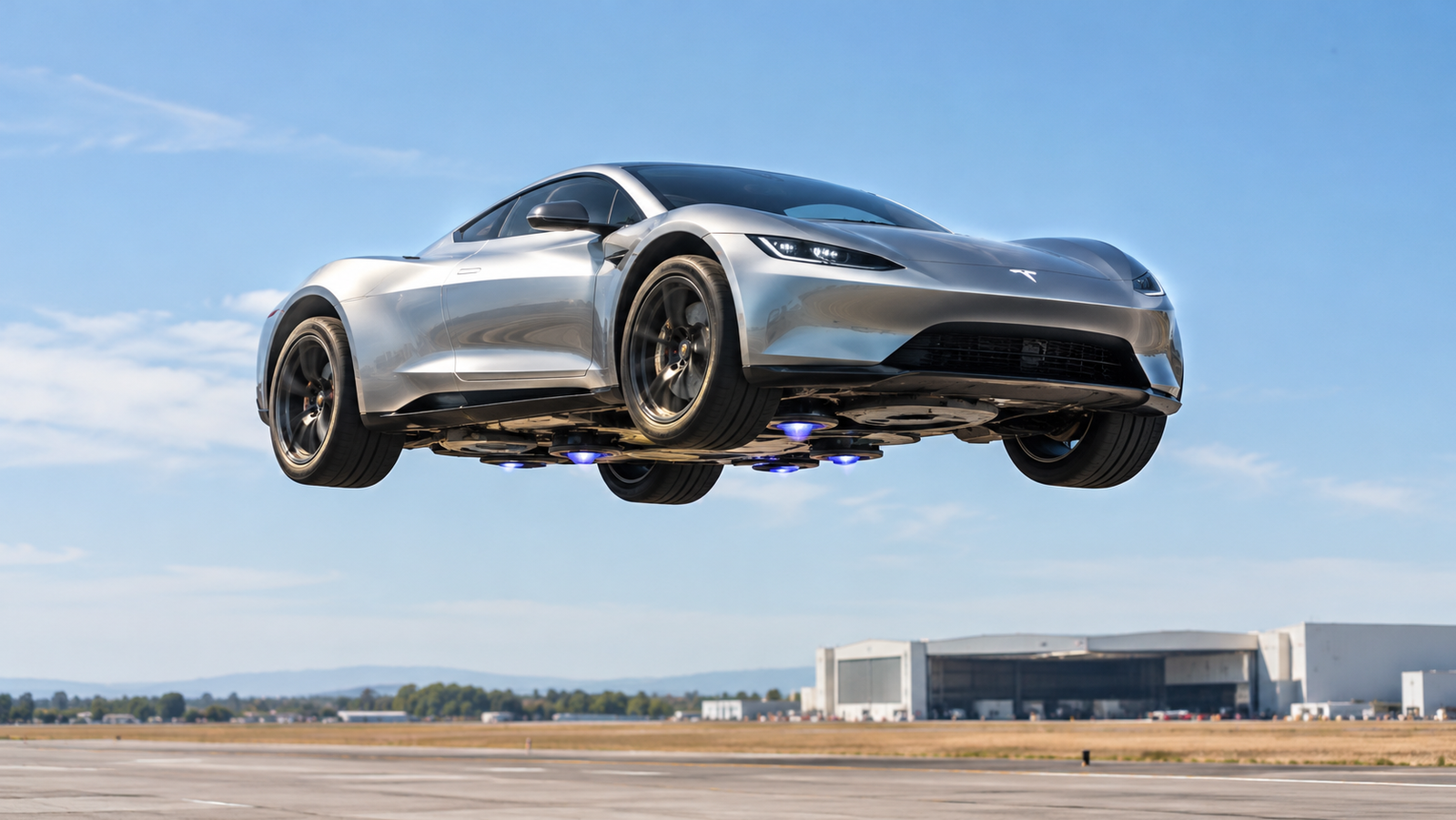
The Tesla flying car discussion has attracted attention from people interested in electric vehicles and futuristic transportation. However, readers should distinguish between confirmed Tesla announcements, experimental vehicle concepts and unverified claims circulating online. Interest in the Tesla flying car concept raises important questions about safety, propulsion technology and practical use. A vehicle that briefly becomes airborne is not necessarily a fully functional flying car, and any claims about a real demonstration should be supported by reliable evidence.
The vehicle used specialised propulsion thrusters to perform airborne stunts, giving audiences a glimpse of an unusual approach to the future of automotive technology. However, there is an important detail behind the headlines: the demonstration does not mean that fully practical flying cars are ready for everyday travel. Tesla flying car’s rocket-equipped Roadster remains an ambitious project, with production targeted for 2028 and important questions surrounding safety, regulation and availability.
Tesla Flying Car: What Did Elon Musk Reveal?
Elon Musk introduced the new Roadster Tesla flying car during an event at a SpaceX testing facility in Texas. The demonstration showed the vehicle moving along a specially designed curved ramp before launching into the air, turning and landing on its wheels. In another stunt, the car appeared to jump over other vehicles. The demonstration was designed to showcase the capabilities of the experimental propulsion system and the engineering collaboration between Tesla and SpaceX.
Musk described the project as an example of what can happen when electric-vehicle technology meets aerospace engineering. The unveiling quickly attracted attention because conventional electric cars are designed to accelerate on roads, while the rocket-equipped Roadster demonstrated movement that looked more like a science-fiction vehicle. Still, the demonstration needs to be understood in context. The car performed specific manoeuvres in a controlled environment. It did not demonstrate sustained flight over long distances or routine travel through public roads.
How Does Tesla’s Flying Car Technology Work?
The rocket-equipped Tesla Roadster uses a combination of automotive engineering and propulsion technology inspired by SpaceX. According to reports from the demonstration, the system includes high-pressure gas tanks and specialised thrusters that help propel the vehicle during its airborne manoeuvres. The Roadster also demonstrated a suction system designed to help it remain attached to a specially constructed ramp while travelling upside down.
These technologies serve different purposes. The suction system helps the vehicle maintain contact with the ramp, while the thrusters provide force for the airborne stunts. In simple terms, a conventional electric car uses its motor to turn its wheels. A propulsion system that pushes a vehicle into the air introduces a different engineering challenge because the vehicle must also manage its movement and landing. That is why the demonstration is technically unusual. However, a brief airborne manoeuvre is not the same as a practical flying car capable of taking off, travelling through the air and landing safely in everyday conditions.
Tesla Roadster 2026: Speed and Performance
The new Roadster Tesla flying car attracted attention not only for its airborne stunts but also for its claimed acceleration. During the presentation, Tesla executives discussed a target of accelerating from zero to 60 miles per hour in less than one second. The company also presented the vehicle as a high-performance electric sports car with a top speed exceeding 230 mph. These are extraordinary performance claims, but readers should distinguish between announced specifications and independently verified production-vehicle performance.
The rocket-equipped version is also different from a conventional electric sports car because its additional propulsion technology introduces further engineering and safety considerations. Tesla has not yet demonstrated that the rocket-equipped Roadster can operate as an ordinary flying vehicle in public traffic. For potential buyers, the final production specifications, independent testing and applicable safety requirements will be important factors to watch.
When Will Tesla’s Flying Car Launch?
One of the biggest questions following the unveiling is when customers will be able to receive the new Roadster. Musk said production was expected to begin in 2028. This is the company’s stated target, not a guarantee that every version will be available to customers by that date. The Roadster Tesla flying car has faced a lengthy development process. Tesla first presented its next-generation Roadster concept in 2017, and its planned arrival has been delayed several times.
The rocket-equipped version also introduces additional challenges that go beyond those associated with a conventional sports car. These include testing the propulsion system, establishing safe operating procedures and determining how the vehicle can be used under applicable transportation regulations. The timing of customer deliveries will therefore depend on how development progresses and which versions Tesla ultimately brings to market.
What Is the Price of Tesla’s Flying Car?
The price is another important question for people interested in the rocket-equipped Roadster. Tesla’s reservation options following the unveiling included different versions of the vehicle. Reuters reported that the Performance version required a $50,000 reservation deposit, while the Thrust version required a $250,000 deposit. The Rocket version, featuring a full flight system, was listed as invite-only.
These figures refer to reservation deposits, not the final confirmed purchase price of every version. The Rocket version is particularly different from an ordinary sports car because its full flight system is intended for specialised use. It should not be treated as a widely available vehicle that customers can immediately purchase and drive on public roads. Anyone considering a reservation should check Tesla’s official website for the latest terms, specifications and availability before making a financial commitment.
Is Tesla’s Flying Car Street Legal?
Despite the excitement surrounding the demonstration, the legality of the rocket-equipped Roadster is a major issue. A conventional electric car must meet the safety and regulatory requirements applicable to road vehicles. A vehicle capable of airborne manoeuvres may raise additional questions about how it can be operated, where it can be used and which authorities have jurisdiction over its activities.
Tesla’s Rocket version has been described as not approved for public-road use. The demonstration therefore should not be interpreted as permission to operate the vehicle like an ordinary car on public streets. Before a rocket-equipped vehicle could be used more widely, its technical capabilities and intended operating conditions would need to be considered alongside the relevant safety and regulatory requirements. The final rules may also depend on the country or region in which the vehicle is intended to operate.
Is Tesla Really Building a Flying Car?
The answer depends on what is meant by a Tesla flying car. The new Roadster demonstrated that a specially equipped vehicle can perform brief airborne manoeuvres using additional propulsion technology. That is a remarkable engineering demonstration, but it does not establish that the car can replace an aircraft or function as a conventional flying vehicle.
A practical flying car would need to offer reliable control, safe operation, predictable landings and a workable approach to transportation regulations. It would also need to demonstrate that its technology can function consistently beyond a carefully controlled presentation. For now, the Tesla Roadster is best understood as an experimental, high-performance electric sports car with rocket-inspired capabilities rather than a proven solution for everyday air travel.
What Tesla’s Flying Car Could Mean for Future Technology
The Roadster Tesla flying car demonstration highlights the growing overlap between the automotive and aerospace industries. Electric vehicles have already transformed expectations around acceleration and power delivery. Aerospace-inspired propulsion introduces another direction for engineers to explore, although turning an experimental system into a practical consumer product remains a considerable challenge.
For everyday drivers, affordability, reliability, safety and usability are likely to matter more than the ability to perform an airborne stunt. The Roadster Tesla flying car may eventually become a showcase for Tesla’s engineering ambitions. Its wider significance, however, will depend on whether the company can turn the demonstration into a commercially viable and appropriately regulated product.
Tesla Flying Car: Key Facts at a Glance
Here are the main details readers should know about the new Tesla flying car Roadster:
- Unveiling: October 15, 2026.
- Location: A SpaceX testing facility in Texas.
- Technology: Rocket-inspired thrusters and a specialised suction system for the demonstration.
- Airborne demonstration: The vehicle performed brief mid-air manoeuvres and landed on its wheels.
- Production target: 2028, according to Musk’s announcement.
- Reservation options: Performance, Thrust and an invite-only Rocket version were reported.
- Public-road status: The Rocket version has been described as not approved for public-road use.
- Everyday flying capability: The demonstration did not establish that the vehicle is ready for routine flight or daily public-road use.
The Tesla flying car demonstration has renewed interest in the future of transportation, but the most important developments are still ahead. Production progress, verified performance and regulatory decisions will determine whether the rocket-equipped Roadster becomes more than an extraordinary technology showcase. For now, readers should approach Tesla flying car claims carefully and look for official announcements and credible reporting before treating viral demonstrations or production timelines as confirmed facts.