


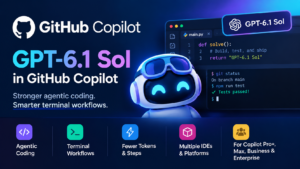
GPT-6.1 Sol in GitHub Copilot is now generally available, giving developers access to OpenAI’s latest Sol-series model for agentic coding and terminal-based development workflows. GitHub announced the rollout on September 29, 2026, describing GPT-6.1 Sol as a model designed for strong multistep coding performance and efficient token use. In early testing, GitHub said the model completed tasks while using noticeably fewer tokens and steps than earlier models in the GPT-6 and GPT-5.6 families. T
he release adds another OpenAI-powered option to GitHub Copilot as AI-assisted programming continues to move beyond simple code suggestions toward more advanced development workflows.
What Is GPT-6.1 Sol?
GPT-6.1 Sol is part of OpenAI’s GPT-6 model family. The Sol line is designed to balance AI capability, speed and cost, making it particularly relevant for workloads that require strong performance without always relying on the highest-capability model.
GPT-6.1 Sol is focused on coding, computer use and complex professional workflows. For developers, this means it can be used for tasks that go beyond generating an isolated piece of code. In an agentic development workflow, an AI model may need to understand a task, inspect an existing project, modify multiple files, run commands and respond to the results. GPT-6.1 Sol is designed for these types of multistep interactions.
GPT-6.1 Sol Comes to GitHub Copilot
The arrival of GPT-6.1 Sol in GitHub Copilot gives developers another model option for AI-assisted software development. GitHub says the model is generally available and is rolling out to eligible Copilot users. It is specifically available for agentic coding and terminal workflows, where completing a development task can require multiple actions rather than a single response.
The model joins other AI models available through GitHub Copilot, giving developers more flexibility when selecting an AI system for different coding requirements.
Designed for Agentic Coding
One of the most important aspects of GPT-6.1 Sol is its focus on agentic coding. Traditional AI coding assistants generally help developers generate code, explain errors or suggest changes. Agentic coding takes this further by allowing AI systems to work through a sequence of connected development tasks.
For example, a coding agent may need to:
- Understand an existing codebase
- Locate relevant files
- Modify several files
- Run tests or commands
- Examine the results
- Identify and correct errors
- Make additional changes
- Prepare the changes for review
GPT-6.1 Sol is designed to handle these kinds of multistep workflows within GitHub Copilot. GitHub reported in its early testing that GPT-6.1 Sol could complete coding tasks while using fewer tokens and steps than earlier models in the GPT-6 and GPT-5.6 families.
GPT-6.1 Sol for Terminal Workflows
Another important area for the new model is terminal-based development. Developers frequently use command-line tools to navigate repositories, install dependencies, run tests, manage files and automate development processes. AI assistance in these environments can therefore involve more than simply writing code.
Because GPT-6.1 So is available for terminal workflows, developers can use it as part of command-line development tasks through supported GitHub Copilot experiences. This can be particularly useful when a development task requires several commands and decisions to reach a result.
Where Can You Use GPT-6.1 Sol?
GitHub says GPT-6.1 Sol is rolling out across several Copilot products and development environments.
Supported experiences include:
- Visual Studio Code
- Visual Studio
- GitHub Copilot CLI
- GitHub Copilot coding agent
- GitHub Copilot app
- GitHub.com
- GitHub Mobile
- JetBrains IDEs
- Xcode
- Eclipse
The model is available to eligible Copilot Pro+, Max, Business and Enterprise users. Because the rollout is gradual, some users may not immediately see GPT-6.1 Sol in their Copilot model picker. Availability can depend on the user’s plan and the specific Copilot experience being used. For Business and Enterprise customers, administrators can also manage model access through Copilot’s model policy settings.
GPT-6.1 Sol Focuses on Efficient AI Coding
Efficiency is another key part of the GPT-6.1 Sol release. AI coding agents can make multiple model calls while working on a complex task. They may also use tools, inspect files and process large amounts of code. Reducing unnecessary steps and token usage can therefore improve the efficiency of these workflows.
GitHub’s early testing showed that GPT-6.1 Sol used noticeably fewer tokens and steps than earlier GPT-6 and GPT-5.6 models while completing coding tasks. For developers, this can be important when working on larger repositories or tasks that require multiple rounds of interaction with an AI coding agent.
GPT-6.1 Sol and the GPT-6 Family
GPT-6.1 Sol is part of a wider GPT-6 model family designed for different types of workloads. OpenAI’s model lineup includes higher-capability models as well as options focused on efficiency and cost. This allows developers to select a model based on the complexity of the task they are trying to complete.
Within GitHub Copilot, this broader model selection means developers can choose between different AI systems rather than relying on a single model for every programming task. For example, a simple coding question may not require the same level of reasoning as a large debugging task involving multiple files and tests.
What Does GPT-6.1 Sol Mean for Developers?
The addition of GPT-6.1 Sol reflects the wider shift taking place in AI-assisted software development. AI coding tools are increasingly moving from autocomplete-style assistance toward systems that can participate in longer development workflows.
For developers, this can mean using AI to assist with coding, debugging, repository changes, terminal operations and other multistep tasks. However, AI-generated code still needs to be reviewed and tested. Performance can vary depending on the programming language, repository structure and complexity of the task. Developers should continue to review changes and run appropriate tests before deploying software.
GPT-6.1 Sol vs Other Copilot Models
GitHub Copilot now provides access to models from several AI companies and model families. The available options can differ in their capabilities, speed, cost and suitability for particular programming tasks. This growing model selection gives developers more flexibility when deciding how to approach AI-assisted development.
For straightforward coding tasks, developers may prefer a faster or more economical model. More complicated agentic workflows can require models with stronger multistep reasoning and tool-use capabilities. GPT-6.1 Sol is positioned within this ecosystem as an option for developers who want strong coding performance alongside efficient execution.
GPT-6.1 Sol Is Rolling Out Now
GPT-6.1 Sol in GitHub Copilot is now generally available to eligible users, with the rollout continuing across supported plans and development environments. Its primary focus is agentic coding and terminal workflows, while GitHub’s early testing highlights its ability to complete multistep coding tasks with efficient token and step usage.
For developers, the release provides another option in an increasingly competitive AI coding ecosystem. As GitHub Copilot continues to expand its model selection, developers can choose models according to the complexity of their projects, coding requirements and preferred workflow. The arrival of GPT-6.1 Sol also highlights how quickly AI coding is evolving from simple code assistance toward AI systems capable of participating in longer and more complex software-development processes.