


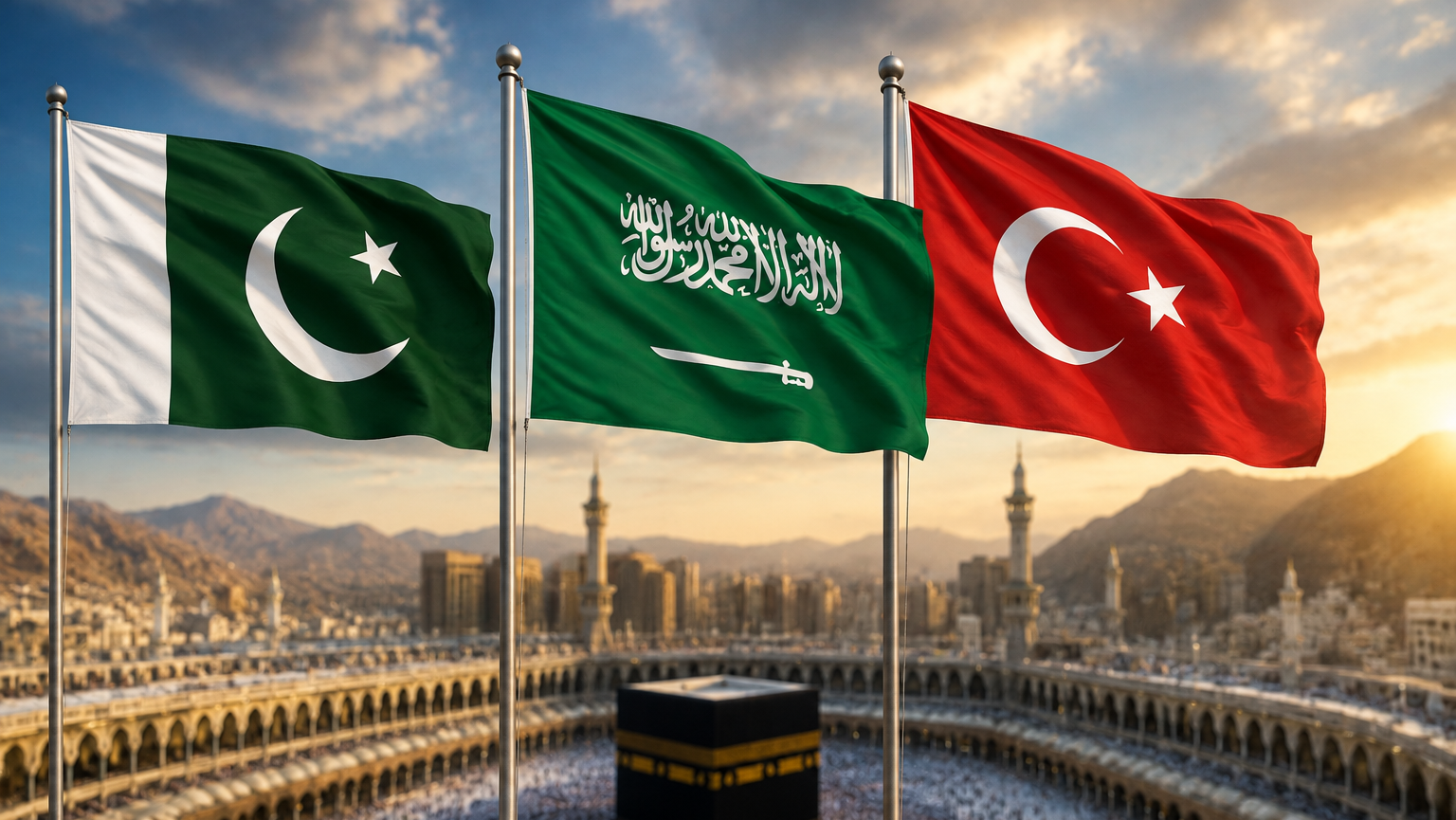
The Makkah Joint Defence Agreement marks an important development in the evolving security relationship between Pakistan, Saudi Arabia and Türkiye. Its collective-defence principle gives the agreement greater strategic importance than a conventional defence-cooperation arrangement.
The agreement comes at a time of heightened regional tensions and follows the earlier Pakistan–Saudi Strategic Mutual Defence Agreement signed in September 2025. While the new trilateral arrangement has attracted comparisons with collective-defence frameworks such as NATO, officials have emphasized that it is a defensive agreement and should not automatically be interpreted as the creation of a NATO-style alliance.
What Is the Makkah Joint Defence Agreement?
The Makkah Joint Defence Agreement is a trilateral security arrangement between Pakistan, Saudi Arabia and Türkiye designed to strengthen cooperation in defence and regional security. Its most significant principle is collective defence: an armed attack against any one of the participating countries will be considered an attack against all three.
The agreement brings together three countries with different but potentially complementary strategic capabilities. Pakistan has extensive military experience and a nuclear deterrent, Saudi Arabia has major economic and regional weight, while Türkiye brings a large military establishment, defence-industry capabilities and NATO experience.
Why Was the Agreement Signed in Makkah?
The choice of Makkah gives the agreement considerable symbolic significance. Saudi Arabia is home to Islam’s two holiest cities, and Makkah has historically carried deep religious and political importance across the Muslim world.
Beyond symbolism, the agreement reflects growing security coordination among three countries that have maintained longstanding political, military and economic relationships. The trilateral framework builds on existing bilateral ties rather than emerging from an entirely new relationship.
How Did Pakistan–Saudi Defence Cooperation Lead to the Pact?
The new agreement follows the Strategic Mutual Defence Agreement between Pakistan and Saudi Arabia, signed on 17 September 2025 in Riyadh by Prime Minister Shehbaz Sharif and Saudi Crown Prince Mohammed bin Salman. That agreement stated that aggression against either country would be considered aggression against both and aimed to strengthen joint deterrence and defence cooperation.
The bilateral pact provided an important foundation for the later trilateral arrangement. Türkiye’s involvement expands the security framework from a Pakistan–Saudi partnership into a broader three-country mechanism connecting South Asian, Gulf and wider Eurasian strategic interests.
What Role Does Türkiye Bring?
Türkiye adds another significant military and technological dimension to the arrangement. As a NATO member with an established defence industry and experience in developing drones, missiles, naval systems and other military technologies, Türkiye brings capabilities that complement the military strengths of Pakistan and Saudi Arabia.
Türkiye also maintains longstanding political and strategic relations with Pakistan and has developed close economic and diplomatic ties with Saudi Arabia. Its participation therefore gives the new arrangement a broader geographic reach and potentially increases opportunities for defence-industrial cooperation among the three countries.
What Does Pakistan Bring to the Partnership?
Pakistan brings decades of military experience and an established defence relationship with Saudi Arabia. The two countries have cooperated through military training, exercises and defence arrangements for decades, with Pakistan previously maintaining a defence contingent in Saudi Arabia under a bilateral arrangement.
Pakistan’s strategic position also connects South Asia with the Gulf region. Its military capabilities, geographical location and long-standing relations with both Saudi Arabia and Türkiye make Islamabad an important participant in any broader regional security framework.
What Does Saudi Arabia Bring?
Saudi Arabia contributes substantial economic resources, regional influence and strategic importance to the agreement. The Kingdom sits at the centre of the Gulf and Red Sea security environment and remains one of the world’s most important energy and economic powers.
Saudi Arabia has also been strengthening its defence capabilities and expanding partnerships beyond traditional security relationships. The new agreement therefore provides Riyadh with another mechanism for strategic cooperation while maintaining its existing relationships with other international partners.
Is the Agreement Similar to NATO?
The agreement has generated comparisons with NATO because of its collective-defence principle. The idea that an attack on one member is treated as an attack on all resembles the basic logic behind Article 5 of the North Atlantic Treaty.
However, the comparison should not be taken too far. Analysts have cautioned against describing the Makkah agreement as a direct NATO equivalent because the institutional structure, obligations, decision-making mechanisms and scope of the arrangements are different.
Is the Makkah Defence Agreement Directed Against Iran?
Pakistan has emphasized that the agreement is purely defensive and not aimed at any particular country. Pakistani officials have also stressed that the arrangement should not be interpreted as an aggressive military bloc directed against another state.
The clarification is significant because the agreement comes amid heightened tensions involving Iran and the wider Gulf region. Iran’s Foreign Ministry has subsequently said there is no reason for Tehran to fear the pact, while describing regional security cooperation and self-reliance as potentially positive if such arrangements are inclusive and address genuine security concerns.
Why the Agreement Matters for the Middle East
The agreement could contribute to a broader shift in how regional states approach security. For Saudi Arabia, closer cooperation with Pakistan and Türkiye provides additional strategic relationships at a time when Gulf security is being reassessed amid continuing regional instability.
It also creates stronger links between the Gulf and South Asia. Pakistan already has a longstanding defence relationship with Saudi Arabia, while Türkiye has expanded its regional engagement, meaning the trilateral arrangement brings together three countries with significant diplomatic, economic and military interests.
Why the Agreement Matters for Pakistan
For Pakistan, the agreement strengthens an already close relationship with Saudi Arabia while deepening strategic cooperation with Türkiye. Islamabad has maintained defence ties with Riyadh for decades, while Pakistan and Türkiye have also developed a broad strategic partnership covering defence, trade and political cooperation.
The agreement could also create opportunities for increased defence-industrial cooperation, military training and strategic coordination. At the same time, Pakistan will need to balance its new commitments with its existing relationships with other regional and global powers.
Could the Agreement Increase Defence Cooperation?
One potential outcome is greater cooperation in military training, exercises, intelligence coordination and defence technology. Pakistan and Türkiye already have established defence-industrial links, while Saudi Arabia has been seeking to expand and modernize its domestic defence capabilities.
The agreement could therefore provide a framework for cooperation that goes beyond traditional military exercises. However, the precise operational mechanisms and commitments under the new pact will be important in determining how significant this cooperation becomes in practice.
Why the Makkah Joint Defence Agreement Matters
The Makkah Joint Defence Agreement creates a new layer of security cooperation linking South Asia, the Gulf and Türkiye. Each country brings different strategic capabilities and regional relationships, giving the agreement significance beyond a conventional bilateral defence arrangement.
For Pakistan, the agreement strengthens its longstanding relationship with Saudi Arabia while also deepening its strategic partnership with Türkiye. For Saudi Arabia and Türkiye, cooperation with Pakistan provides another channel for military coordination and regional security engagement.
What Does It Mean for Regional Security?
The agreement creates a new security grouping at a time when the region is experiencing significant geopolitical uncertainty. Its importance will depend not only on the text of the agreement but also on how the three countries coordinate their policies and respond to future security challenges.
It is too early to conclude that the pact will fundamentally replace existing alliances or security partnerships. Instead, it may become another layer in an increasingly complex regional security architecture involving Gulf states, South Asian powers, Türkiye and major international partners.
What Could Change in the Future?
The long-term significance of the Makkah Joint Defence Agreement will depend on implementation. If Pakistan, Saudi Arabia and Türkiye expand military exercises, intelligence cooperation, defence production and strategic consultations, the agreement could develop into a more substantial regional security mechanism.
Its future could also depend on whether additional countries become interested in closer cooperation. Pakistani officials have indicated that the arrangement is open to other countries that are prepared to commit to peaceful conflict resolution and strategic cooperation, although any expansion would depend on future political decisions.
A New Chapter in Pakistan–Saudi–Türkiye Relations
The agreement represents a new chapter in relations among Pakistan, Saudi Arabia and Türkiye. Each country enters the arrangement with different strategic interests, but all three have emphasized sovereignty, regional stability and stronger cooperation.
For Pakistan, the agreement reinforces its historic partnership with Saudi Arabia while strengthening its strategic relationship with Türkiye. For Saudi Arabia and Türkiye, it provides another avenue for cooperation with a country that has extensive military experience and long-standing regional relationships.
Final Thoughts
The Makkah Joint Defence Agreement marks an important development in the evolving security environment connecting South Asia and the Middle East. Its collective-defence principle gives the arrangement greater strategic significance than a conventional bilateral defence cooperation agreement, while the participation of Pakistan, Saudi Arabia and Türkiye creates a partnership involving three countries with substantial military, economic and geopolitical weight.
At the same time, it is important not to overstate what the agreement means before its operational details become clearer. The pact has been described by Pakistani officials as defensive and not directed against any specific country, while its comparison with NATO remains limited. Its real significance will ultimately be measured by how the three countries implement the agreement and whether it contributes to greater regional stability.