


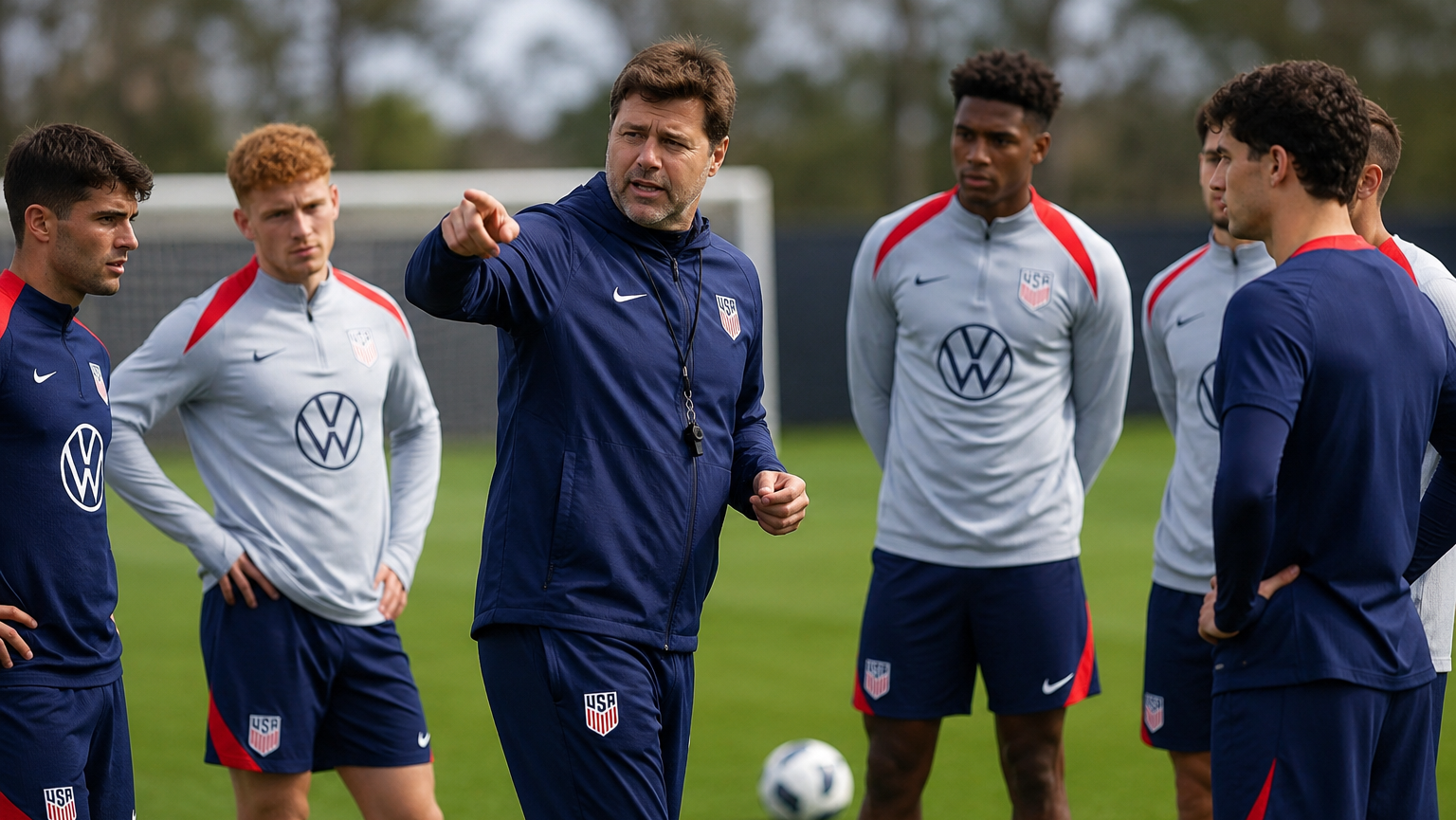
USMNT is entering a new chapter after U.S. Soccer announced four international friendlies against Peru, Chile, Mexico and Canada as Mauricio Pochettino begins the next phase of his tenure.
The matches will mark the United States Men’s National Team’s first games following the 2026 FIFA World Cup and the beginning of a new cycle toward the 2030 World Cup. Pochettino has agreed to continue leading the team through 2030, giving the Argentine coach more time to develop the squad and establish his long-term vision.
The four-match schedule will give the USMNT an early opportunity to assess players, introduce emerging talent and begin shaping the team’s identity for the next four years.
USMNT Will Open Against Peru in Orlando
The new cycle will officially begin on September 26, when the USMNT hosts Peru at Inter&Co Stadium in Orlando, Florida.
The match will serve as a Fan Appreciation Match, giving American supporters their first opportunity to welcome the team back following the World Cup.
Kickoff is scheduled for 4:30 p.m. ET. The match will also give Pochettino his first chance to test his squad in the new cycle in front of a home crowd.
Chile Provides the Next Test
Just three days after facing Peru, the USMNT will take on Chile on September 29 at Energizer Park in St. Louis, Missouri.
The match will give Pochettino another opportunity to experiment with his lineup and evaluate players against South American opposition.
The short gap between the two matches could also encourage squad rotation and provide opportunities for younger players hoping to establish themselves in the national team.
Mexico Rivalry Returns in October
The schedule becomes even more significant on October 3, when the United States renews its rivalry with Mexico at State Farm Stadium in Glendale, Arizona.
The USA-Mexico rivalry remains one of the most closely followed matchups in the region, making the October meeting one of the most anticipated games of the four-match window.
For the USMNT, the match will provide a competitive test against a familiar CONCACAF opponent while also giving Pochettino another opportunity to assess his squad.
The game is scheduled for 7 p.m. MT.
Canada Will Complete the Four-Match Run
The USMNT will close the four-game schedule against Canada on October 6 at Allianz Field in St. Paul, Minnesota.
The match will bring another important regional rivalry into the opening phase of the new cycle.
With Peru and Chile providing South American opposition and Mexico and Canada offering CONCACAF competition, the schedule gives Pochettino a varied set of challenges.
The Canada match is scheduled for 7 p.m. CT.

Pochettino Gets a Long-Term Opportunity
One of the biggest developments surrounding the USMNT is Pochettino’s new contract through the 2030 World Cup.
The Argentine coach took charge of the team in 2024 and originally had an agreement that ran through the 2026 tournament. U.S. Soccer has now committed to continuing the project with him through the next World Cup cycle.
That longer commitment could provide greater stability as the federation works to develop the men’s national team.
Instead of preparing for only one major tournament, Pochettino can now focus on developing a squad capable of competing over a longer period.
World Cup Experience Sets the Starting Point
The USMNT enters the new cycle after a mixed but ultimately historic 2026 World Cup campaign.
The United States finished first in its group ahead of Australia, Paraguay and Turkey, collecting six points—the men’s team’s highest-ever World Cup group-stage points total.
The Americans then defeated Bosnia and Herzegovina in the Round of 32 before suffering a 4-1 defeat to Belgium in the Round of 16.
The result ended hopes of a deep home-tournament run, but the campaign also gave Pochettino valuable information about his squad.
The next challenge will be turning that experience into long-term progress.
New Players Could Get Their Opportunity
The period immediately after a World Cup can be important for players competing for places in the national team.
Established stars will remain important to the USMNT, but the next cycle is also likely to create opportunities for emerging players.
Pochettino will have to balance experience with development while identifying players who can contribute through 2030.
The four upcoming friendlies should provide valuable minutes for different combinations and tactical approaches.
What the New Cycle Means for American Soccer
The next four years could be particularly important for soccer in the United States.
The 2026 World Cup generated enormous attention across the country, while the national team now has an opportunity to build on that momentum.
The USMNT will also benefit from playing four high-profile matches on home soil, allowing supporters across several American cities to see the team during the early stages of the new cycle.
Pochettino has emphasized the importance of playing strong opponents as the team begins its next chapter.
The Road to 2030 Begins Now
The four matches against Peru, Chile, Mexico and Canada are friendlies, but they represent the first steps toward the 2030 World Cup.
For Pochettino, the priority will be identifying the right players, developing tactical consistency and creating a team capable of competing against stronger international opposition.
For the USMNT, the next phase is about more than individual results.
It is about building a team with a clear identity and enough depth to remain competitive throughout the next four years.
Conclusion
The USMNT is officially beginning a new era under Mauricio Pochettino.
With Peru, Chile, Mexico and Canada scheduled between September and October, the United States will have four major opportunities to test its squad and begin developing the next generation of the national team.
Pochettino’s contract through 2030 provides the stability to build beyond a single tournament, while the World Cup experience gives the team a foundation to work from.
The results of the upcoming friendlies will be worth watching, but the bigger story will be how the USMNT develops from this point toward the 2030 World Cup.
Disclaimer: Match schedules, venues, broadcast details and other event information can change. Readers should check official U.S. Soccer sources for the latest updates.